



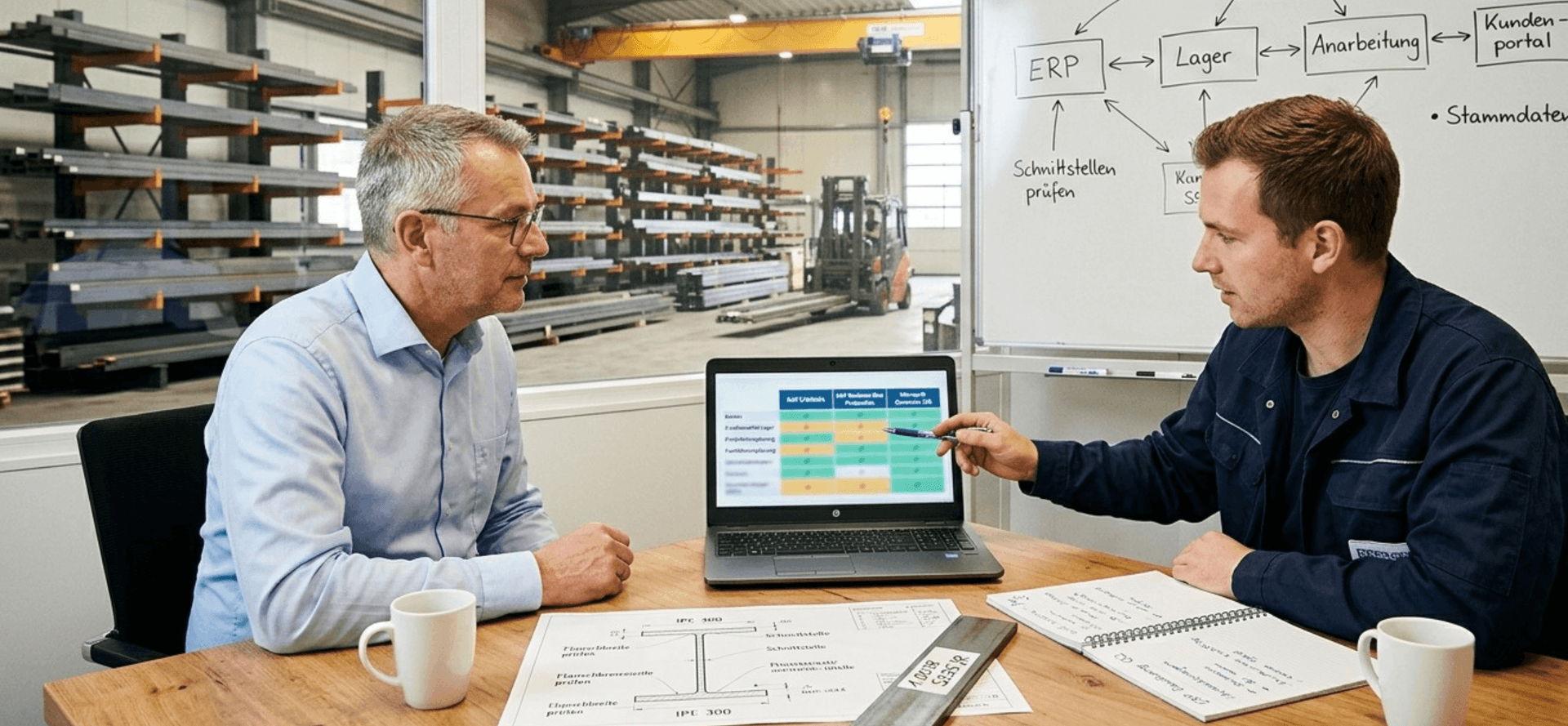
Hardly a week passes without a new AI announcement: demand forecasting, automated certificate processing, stock optimization, pricing. The promises are big - and the potential is real, particularly in steel and metals trading with its document-heavy processes and the capital tied up in the yard. Yet in practice, many AI initiatives get stuck in pilot status. They do not fail on the technology - they fail on what lies beneath it.
The figures from Germany's industry association Bitkom draw a clear picture: in a survey of 555 industrial companies, 57 percent name missing data and 48 percent inadequate IT infrastructure as reasons why such projects frequently fail (Bitkom, 2025). And only six percent of companies consider the potential of their own data fully used today (Bitkom, 2024).
The cause is almost always the same: scattered, incomplete or contradictory data - and behind it, processes running past the system.
Sequence is everything
Digital systems in a trading house build on one another - in a clear layering, in which each level is the precondition for the next:
The ERP system is the base. Orders, stock, purchasing, processing, batches, certificates - the operational business runs through the ERP. On top of it sits the integration layer, connecting warehouse management, processing, webshop and CRM to the core system instead of letting point solutions run side by side. Above that, the data platform and business intelligence, turning movement data into decision-relevant figures - on-time delivery, yield, margin per order. And at the top: AI.
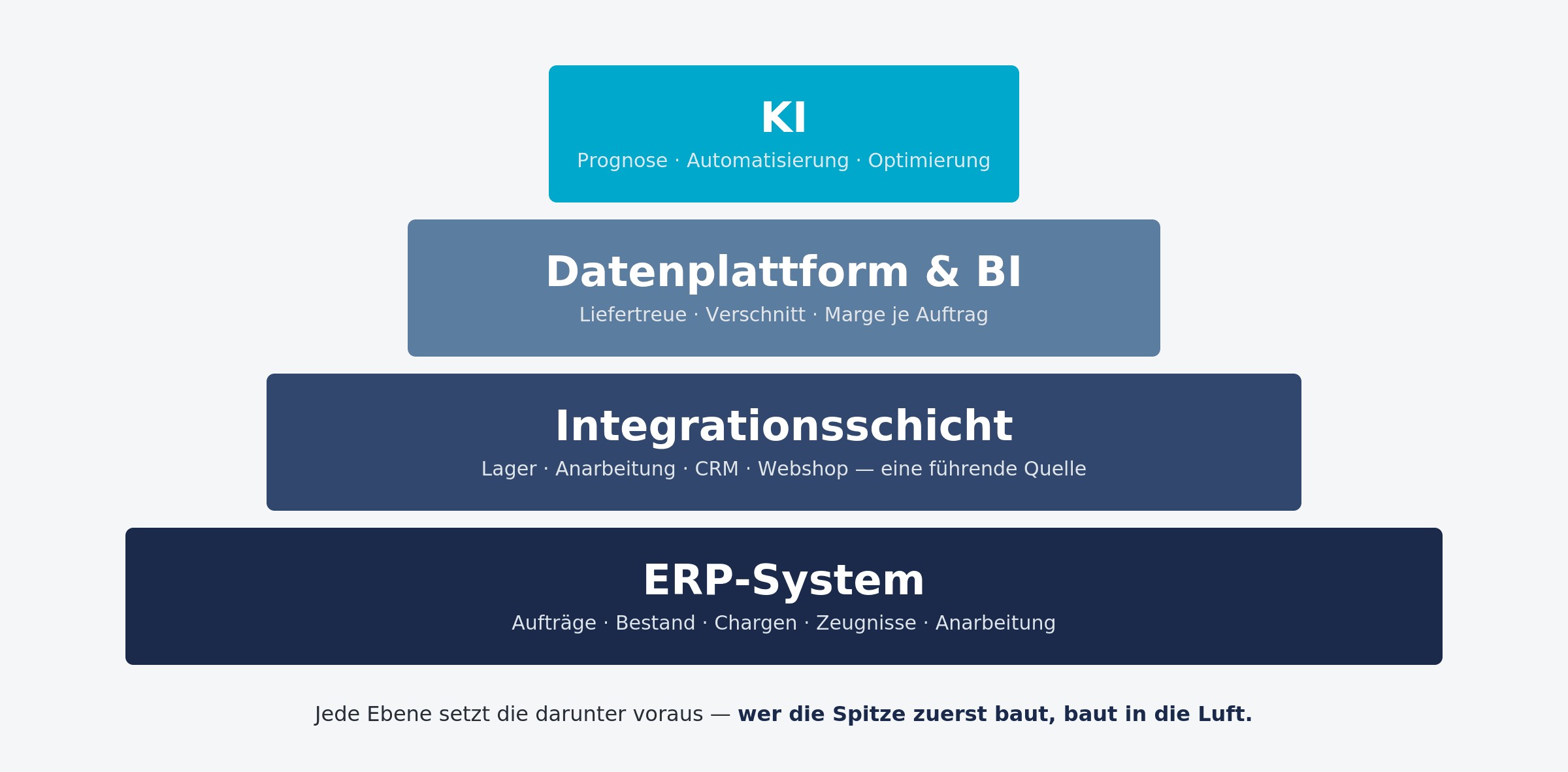
This sequence is not a matter of taste. Whoever inverts it builds the top first - and wonders why it hangs in mid-air.
The root problem: garbage in, garbage out
The oldest principle in computing applies to AI without restriction - more than that: AI sharpens it.
An example from everyday trading: a stockholding distributor introduces AI-based stock optimization. The model is meant to forecast demand and generate order proposals. In the ERP, however, material master data is maintained inconsistently - the same grade runs as 1.4301, as "V2A" and as free text. Offcut plates and remaining lengths are not in the system but on a list in the warehouse office. Reservations are booked late. The result: the model forecasts on the basis of a stock truth that isn't one - and reorders material already sitting in the yard, while in-demand dimensions run short. Faster and at greater scale than any human ever could.
The error was not in the model. It was in the foundation.
"AI projects in steel trade rarely fail on the technology and almost always on the data foundation. If master data, interfaces and processes in the ERP won't carry the load, even the best model won't help. That is exactly the gap we close — before it becomes an investment risk." Kapil Gupta · Managing Director, Zirkel Technologies GmbH
Three questions that come before every AI project
1. Is our data complete, consistent and current? Data does not have to be perfect — but it has to be dependable. Gaps in the material master, duplicate customer records, outdated terms or missing batch assignments are not trivia for a model; they are error sources with leverage.
Typical warning signs:
- The same grade is held differently in ERP, warehouse system and CRM
- Certificates sit as PDFs on a shared drive, with no link to the batch
- Reports from the ERP and from Excel deliver different numbers
- Staff do not trust the system data and keep their own lists
2. Does our ERP map our processes end to end? An ERP is only as good as its consistent use - by everyone, under the same rules. If quoting, processing and shipping follow different logic or bypass the system entirely, data islands form that no model can reliably merge.
Typical warning signs:
- The alloy surcharge is maintained in a spreadsheet, not in the system
- Order steering runs on manually kept lists instead of through the ERP
- Confirmations from the hall reach the core system late or not at all
3. Do we have a reliable analytics layer? KPIs are the link between raw data and decisions. Whoever cannot measure on-time delivery, yield and margin dependably today will not be able to evaluate AI-generated recommendations tomorrow - because the yardstick to check them against is missing.
What "clean data" means in daily trading
Data quality is not an abstract IT topic; it is a business decision with clear dimensions: completeness (every batch has its certificate, every article its standard), consistency (one leading source per data object - not two opinions in two systems), currency (confirmations from processing and warehouse in real time, not at month-end), and traceability (every change logged and auditable).
Why AI doesn't forgive errors - it scales them
An experienced clerk who does not trust a stock figure calls the warehouse before ordering. That human corrective is invisible - and it disappears the moment a model takes the same figure at face value and derives order proposals across every storage location simultaneously.
AI amplifies what is already there. Good data becomes more valuable through AI. Bad data becomes a systemic risk - and a single error becomes a series.
The path to AI readiness, step by step
1. Consolidate and modernize the ERP. Whoever runs several point solutions, or a system that cannot map their processing depth, starts here - assessed vendor-neutrally, decided on process, not on label
2. Establish integration. Warehouse management, processing, CRM and webshop belong connected to the core system through an integration layer - on a MuleSoft basis, for instance - so that one leading source per data object emerges.
3. Make data maintenance a discipline. Data quality is not a project but a permanent state with clear ownership: who maintains the material master? Who validates batch assignment?
4. Build the analytics layer. Only when on-time delivery, yield and margin are measured reliably - and decision-makers trust the numbers - is the ground prepared for AI.
5. Deploy AI deliberately. On this foundation, AI delivers its potential - as a forecasting, automation and analysis instrument: fast, scalable, dependable.
Conclusion: the first step is clarity, not AI
AI is not a shortcut. The real homework reads: reliable data and continuous processes in an integrated system landscape. Whoever has that foundation will convert AI into measurable competitive advantage. Whoever does not risks scaling very bad results very quickly, on a large budget.
Whether your foundation holds can be tested - before the investment. With the Data & AI Readiness Assessment, Zirkel Technologies evaluates whether your SAP or Microsoft Dynamics 365 environment can carry operational AI: master data quality, interface and integration capability, data availability for stock, processing, on-time delivery and pricing, and the connection to downstream data platforms. The output is a prioritized list - what holds, what is missing, what remediation costs, and which use case pays back first.
← Back to Insights