


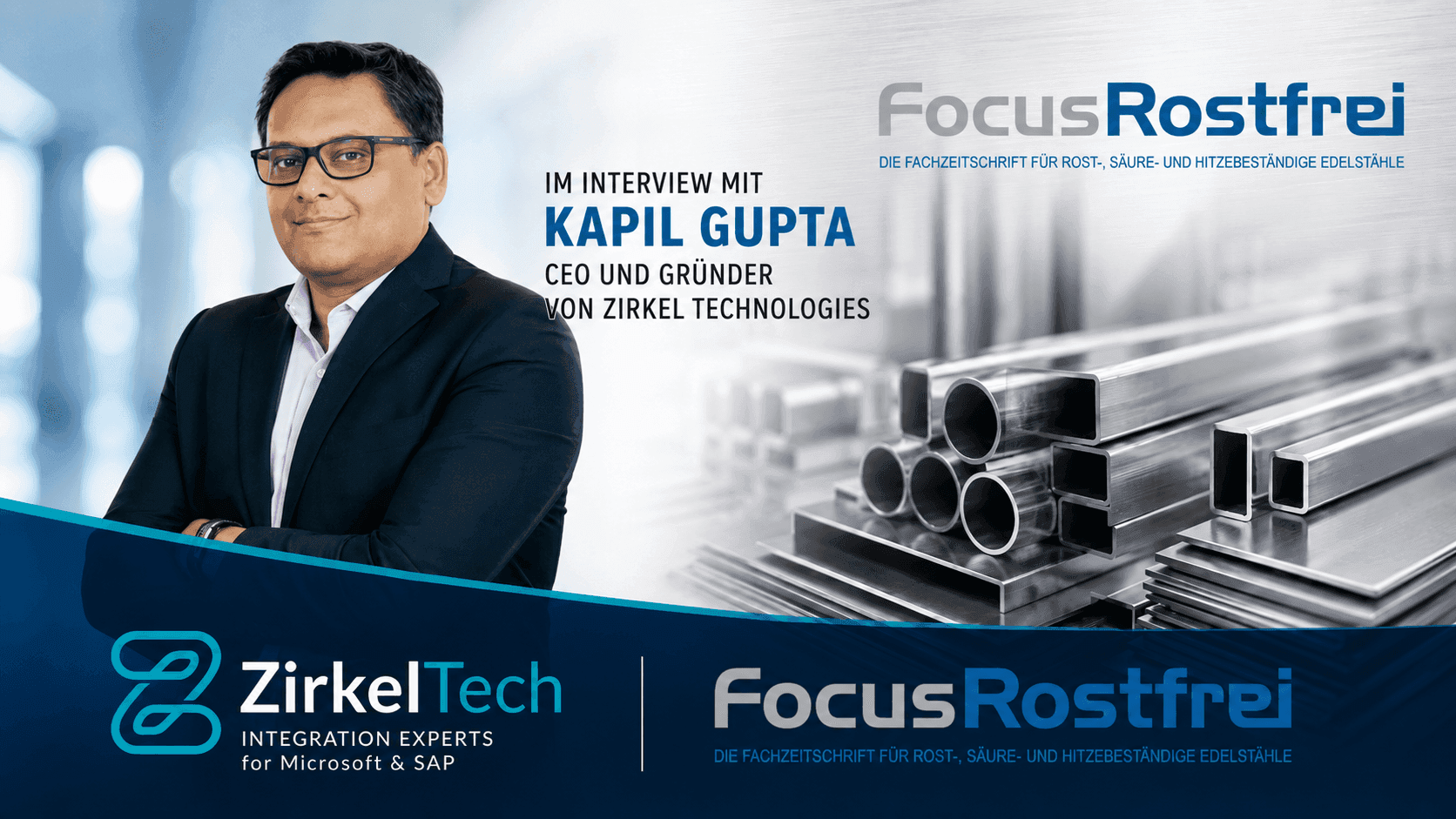
Kapil Gupta, CEO and founder of Zirkel Technologies, comes from a family that has been active in steel trading in India for more than 40 years and later expanded into steel construction and pipeline construction: "I understand the complexity of the steel business - and stainless steel trading takes that complexity to an even higher level: volatile alloy surcharges, demanding material grades, regulated end-customer industries. That is exactly what attracts us, because this is where standard IT solutions reach their limits fastest."
Gupta knows the basic mechanics of steel trading from the family business. The stainless steel segment adds specific layers: pricing is more dynamic, he explains, because alloy surcharges are linked to nickel, chromium and molybdenum quotations and change monthly. The variety of materials is greater - austenitic, ferritic, martensitic and duplex grades with different surfaces and standards. "And end customers in pharma, food and chemicals impose requirements on traceability and certification that go far beyond what is customary in carbon steel trading," the CEO notes. "This understanding flows directly into system configuration.
We don't start conversations with stainless steel traders at the basics - we talk about the concrete requirements: How does the ERP reflect alloy surcharges on a daily basis? How are ASTM and EN standards maintained in parallel? How does batch traceability work for an FDA-compliant supply chain?"
ERP requirements in stainless steel trading
Alloy surcharges, material standards (EN, ASTM, JIS), surface specifications, customer-specific cutting - asked which requirements an ERP system in stainless steel trading absolutely has to meet, Gupta answers: "Six areas are decisive. First, dynamic alloy surcharge calculation, linked to market quotations and able to differentiate between order date and delivery date. Second, multi-standard capability - one material may need to be held simultaneously as 1.4301, 304 (ASTM) and SUS 304 (JIS), with cross-references in the material master. Third, surface and format management - 2B, BA, ground, polished, each with its own price premiums. Fourth, end-to-end batch traceability with works certificates to EN 10204 3.1/3.2 and, where applicable, NACE-, PED- or FDA-compliant documentation. Fifth, integrated processing control for cutting, edge working and slitting, with material-loss and remnant management. Sixth, multi-currency and multi-site capability, since stainless steel is procured internationally."
Traceability and compliance
Stainless steel ends up in highly regulated applications - the food industry, pharma, medical technology, offshore. Solutions from Zirkel Technologies support gap-free documentation along the supply chain. "In stainless steel trading, traceability is not a nice-to-have feature - it is a precondition for doing business," Gupta says. "If a pharma customer [raises a complaint about a sheet, we must be able to prove] which heat it came from, which inspections it passed, and who processed it and when. We configure ERP systems so that the batch number is carried from goods receipt through every processing stage to delivery - including automatic assignment of works certificates to EN 10204, documentation of inspections and releases, and digital certificate delivery to the customer. In splitting operations - when a coil is divided into sheets or a bar into cut pieces - traceability is preserved end to end through batch inheritance. For sector-specific requirements such as NACE MR0175, PED 2014/68/EU or FDA compliance, we adapt the documentation logic accordingly."
System landscape and integration
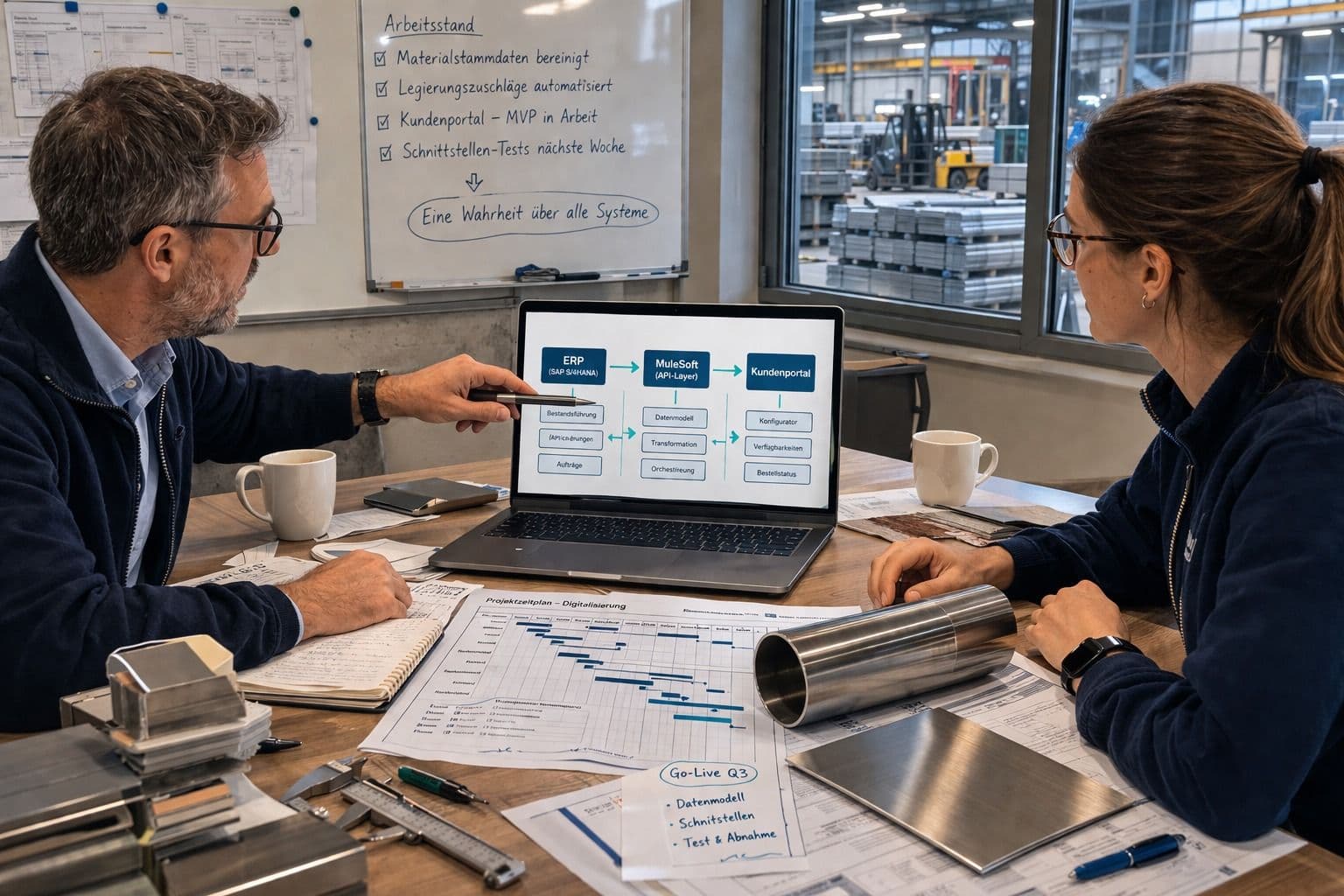
Many stainless steel traders run ERP, warehouse management, Excel-based alloy surcharge calculations and a separate CRM in parallel. "That is the reality at many stainless steel traders," Gupta says, "and it is costly. If the alloy surcharge is maintained in a spreadsheet, availability sits in the warehouse system and sales works in the CRM, you get media and time breaks that translate directly into quoting speed and error rates. A customer asks for 50 t of 1.4571 sheet in 6 mm - and sales has to consult three systems before it can answer. Our approach: integration on one platform where possible. Where a complete replacement is not realistic, we connect existing systems through integration layers such as MuleSoft, so that price, stock and customer data are continuously available in real time. The goal is always a single truth for material, price and availability - no matter how many systems run in the background."
The right ERP solution by company size
SAP S/4HANA, SAP Business One Production, Microsoft Dynamics 365 - Zirkel Technologies advises with company size firmly in view:
- SAP S/4HANA for internationally structured stainless steel groups with multi-entity structures, complex intercompany flows and deep integration requirements - typically from €500 million revenue upward.
- SAP Business One Production is the sweet spot for mid-sized stainless steel traders and service centers in the €50–500 million revenue range: full production and processing control on the SAP stack, implementable in four to six months, at a fraction of S/4HANA cost.
- Microsoft Dynamics 365 suits specialized niche traders without heavy processing who are at home in the Microsoft ecosystem and value intuitive operation and strong CRM integration.
Decisive for stainless steel trading: each of these systems has to be configured for alloy surcharge logic and a multi-standard material master. That is not a standard setup - it takes sector understanding in the implementation team.
Digitalizing the customer relationship
Buyers increasingly expect digital channels - meaning real-time availability, online quote configuration with current alloy surcharges, and digital certificate download. Zirkel Technologies typically builds customer portals on Salesforce Experience Cloud, integrated with the ERP via MuleSoft. That enables real-time stock enquiry with grade, dimension and surface; automated quote configuration that prices in the current daily alloy surcharge; order and delivery tracking; and a digital certificate library from which customers can download works certificates per batch themselves.
For stainless steel traders, the alloy surcharge in the quoting tool is particularly relevant. Customers immediately see the current price including surcharge, can configure different grades and dimensions, and receive a binding quote - without a callback and without waiting. "That," Gupta says, "is a real competitive advantage in a market where speed decides orders."
Stainless steel is procured internationally. Zirkel has more than 400 employees across Europe and India - which makes data protection and GDPR compliance essential. The CEO puts it this way: "Data protection is non-negotiable for us. We are fully GDPR-compliant. Customer data is not stored outside the EU. Our teams in India have no access to production systems - access to development and test environments happens exclusively through secured VPN connections or cloud-based working environments. There is no local data storage outside the agreed infrastructure."
On language: all project work at Zirkel Technologies is conducted in German - documentation, specifications, system configuration. Program code is language-neutral anyway. "A large share of our colleagues in India is actively learning German," Gupta reports. "We have in-house German teachers and translators for meetings. The customer experiences no language break."
Future technologies for stainless steel trading
Three technologies deliver the fastest added value to stainless steel trading. First, AI-based document processing - reading in works certificates automatically, classifying them and assigning them to the correct batch. Given the document volume stainless steel traders handle daily, that immediately saves measurable hours of manual work. Second, predictive analytics for stock optimization - particularly in stainless steel, where capital tied up per tonne is significantly higher than in carbon steel, every improvement in demand forecasting has a direct working-capital effect. Third, IoT connection of processing machines - real-time transparency on machine utilization, maintenance needs and order progress. That enables more precise delivery promises and reduces unplanned downtime. In the long term, automated alloy surcharge optimization will also become relevant - AI models that forecast the optimal ordering time for specific grades on the basis of market data and order histories.
Differentiation and concrete customer benefit
In Gupta's view, Zirkel Technologies stands apart from other IT service providers on four points: "Sector knowledge from 40 years of family steel trading. We understand the commercial logic behind the IT requirements - including the stainless-specific complexities such as alloy surcharge dynamics and multi-standard material management. Outcome responsibility instead of hourly billing. We deliver solutions, not consultants. Vendor-independent technology breadth across SAP, Salesforce, Dynamics and MuleSoft. And a 400-strong delivery organization that offers Mittelstand customers enterprise capacity with short lines of communication." And what can stainless steel trading concretely expect? Gupta concludes: "30 to 40 percent faster implementation through our DACH-India model, lower total cost without compromising on solution design and customer communication, end-to-end integration capability from the ERP through the customer portal to the certificate database. And a partner who doesn't need the difference between 1.4301 and 1.4404 explained first."
← Back to Insights