




The Situation
A structural steel fabrication group operating large-scale plants runs a mature, deeply integrated SAP S/4HANA estate - productive for the better part of a decade, with the Project System at its centre: budgets, structures and the transactions of every surrounding module converge on project WBS elements. For fabrication execution, however, the group had selected a best-of-breed steel fabrication suite: length- and heat-aware material management, nesting and offcut optimization, mark-level production tracking and fabrication-grade traceability are exactly what generic ERPs are not built for.
An initial technical evaluation of the integration between the two systems reached a sobering figure: roughly 1,100 person-days across eight module areas, some fifteen months of implementation, and “high” complexity ratings in materials management, production, quality and projects. On numbers like these, best-of-breed strategies die - not because the operational system is wrong, but because the integration bill makes it look unaffordable.
Zirkel Technologies was engaged to analyse that evaluation and answer a precise question: is this the cost of the strategy - or the cost of one particular way of implementing it?
Diagnosis: The Cost Was in the Coupling, Not the Strategy
Working through the evaluation line by line, we traced its effort to four architectural choices, each embedded implicitly rather than argued explicitly:
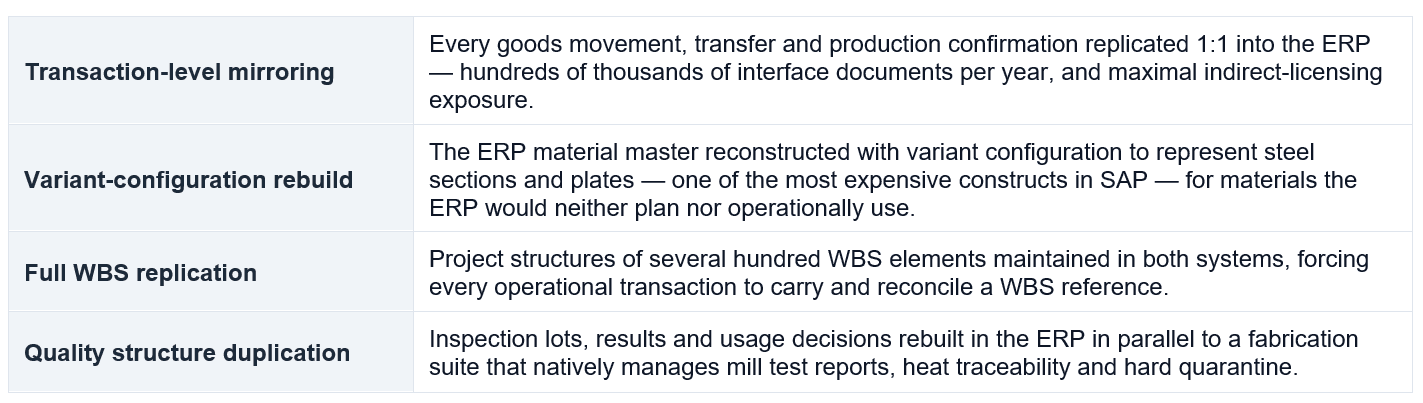
None of these choices was demanded by a business outcome. Each reproduced, inside the ERP, operational detail the fabrication suite already managed natively - at fabrication grade. The strategy was sound; the coupling was expensive.
Method: Evidence-Graded Discovery
Before designing anything, we built a fact base worth designing on. Our structured capability discovery put over one hundred atomic questions to the fabrication platform - each answerable with a single capability code (standard / configurable / customization / not supported), each critical question gated on evidence: a documentation excerpt, a sample export, or a written development commitment with a release date. Blanket assertions were treated as unanswered.
Two disciplines shaped the discovery. First, decision routing: wherever an answer depended on a client policy rather than a platform fact, the respondent stated a capability position and the decision was logged to an open-decisions register with a recommended working assumption - keeping vendor facts and client governance cleanly separated. Second, roadmap discipline: any capability dependent on functionality not yet generally available was classified as development until a GA date was committed in writing. The design that followed rests on verified capability, with every assumption carrying its provenance.
The Re-Architecture: Five Principles, Six Interfaces
The target architecture follows five principles - each traceable to a confirmed discovery outcome:
1. Clean systems of record
The ERP owns commercial, financial and enterprise master data; the fabrication suite owns project execution, steel materials, heats, drops, shop-floor time and operational quality. Confirmed across all fifteen discovery domains - without a single exception.
2. Minimal coupling
No bill-of-material transfer. No work-order or per-confirmation mirroring. No broad replication. Six self-contained exchanges.
3. Interface-specific mechanisms
Each interface selects its carrying mechanism on merit - platform services where validation, acknowledgement, retries and traceability are needed; controlled batch for the genuinely periodic financial summary. No default, no assumed migration.
4. Valuation in the ERP
The ERP values coarse steel categories at standard prices. The fabrication suite supplies quantities, weights and hours - never values. No variant configuration, no second valuation engine.
5. Minimum references, no replication
Controlled mapping keys link the two material worlds; item-level replication and bidirectional synchronisation are designed out entirely.
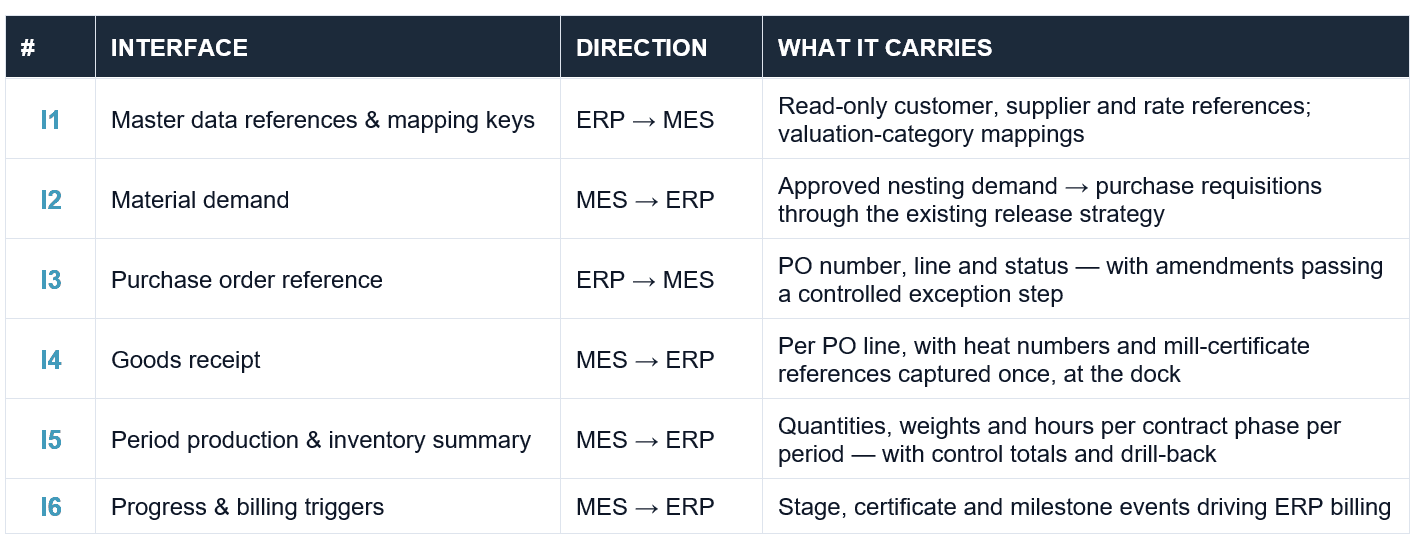
On these principles, the integration collapsed from a module-by-module mesh into six governed interfaces:
THE SINGLE BIGGEST LEVER: WHERE VALUATION LIVES Moving all valuation to the ERP at standard prices changed everything downstream. The fabrication suite no longer needed financial valuation or average costing; the period interface shrank from a valued financial statement to a quantity summary; and reconciliation became structurally clean - quantities reconcile between systems, prices are ERP master data. Any difference decomposes into an investigable quantity delta or a purely ERP-internal price effect.
THE CONSUMPTION TRIGGER Moving material to the workshop is not consumption. Consumption occurs when the first production process on a mark item completes - the operationally correct point, jointly agreed and fixed as the posting trigger. A cleaner accounting definition than movement mirroring could ever provide.
Designed to Be Operated, Not Merely Built
Every interface carries acknowledgements, duplicate-safe reprocessing and a named reconciliation control — six standing reports on a weekly-to-monthly calendar, from mapping completeness to a signed period quantity reconciliation. System integration testing exits only through a full simulated period-end close, and go-live acceptance is defined on the second clean productive close — because the plan assumes the first one teaches lessons. Cutover follows a hardened new-projects-first pattern: no migration of live procurement or production records, stock migrated through a dedicated workstream with an opening reconciliation gate.
Results
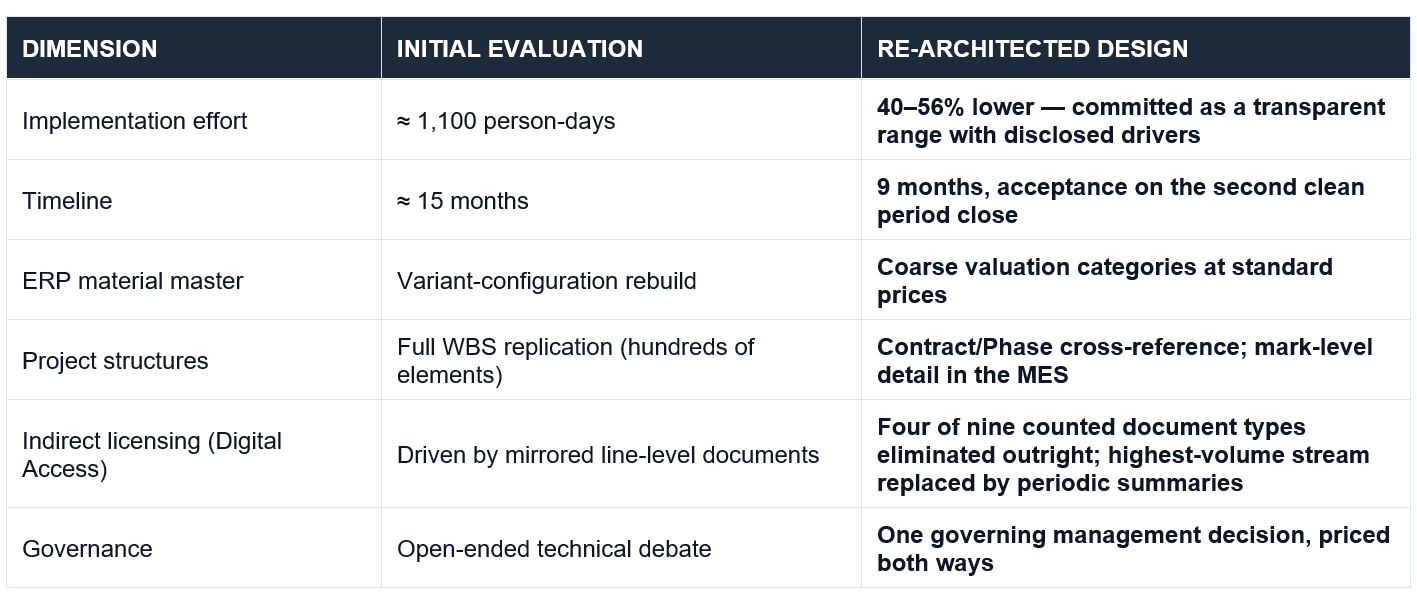
Perhaps the most valuable outcome is the last row. The re-architecture reduced a sprawling technical argument to a single management question: does the enterprise need fabrication-level financial granularity inside the ERP, or contract-level financial control in the ERP with fabrication-level detail served by the system built for it? Framed that way - with both options engineered and priced - the decision belongs where it should: with management, taken explicitly at blueprint, before anything is built.
What We Would Tell Any Manufacturer Facing This Decision
1. Interrogate the coupling before you question the strategy. When a best-of-breed adoption looks unaffordable, the cost usually sits in an assumed integration pattern - not in the second system.
2. Decide where valuation lives first. It is the single largest architectural lever: quantities are easy to exchange and reconcile; values drag a second valuation engine into existence.
3. Grade discovery answers by evidence, not confidence. Capability codes plus mandatory samples for critical questions prevent an architecture built on assertion.
4. Separate vendor facts from client decisions. A discovery that lets the vendor answer governance questions produces self-serving architecture; route those decisions to a register with recommended working assumptions.
5. Design for the period close. Acknowledgements, control totals, a reconciliation calendar and a simulated close as the test exit gate are what make a lean integration auditable - and what make finance its ally.
← Back to InsightsFacing an integration estimate that puts your best-of-breed strategy in question? Talk to our Enterprise Integration Advisory team.