




For a foundry, the request for quotation is where business is won or lost. Every enquiry triggers a chain across sales, technical feasibility, calculation and development - and every single position within it is an engineering object in its own right, with drawing numbers and revision indices, raw-part and finished-part weights, annual volumes and manufacturing processes. When this process lives in inboxes and spreadsheets, cycle times stretch, responsibilities blur and management flies blind.
Franken Guss GmbH & Co. KG, one of Germany's established iron and aluminium foundries, decided to change this - and engaged ZirkelTech from the very first idea. In a multi-year engagement, our teams took the platform from ideation workshops on the foundry floor to a productive system, ran and evolved it in day-to-day operations, and finally hardened it into a multi-tenant, white-label cloud product. At peak, more than 20 ZirkelTech specialists worked on Prolution in parallel across Frankfurt am Main and Delhi NCR, delivering over 70 two-week sprints, more than 30 production releases and upwards of 50,000 engineering hours.
The results were substantial. Innolution GmbH, the company that took Prolution to market, publicly reported that Franken Guss accelerated its RFQ procedure by around 30 percent and markedly improved collaboration between departments. Management gained what it never had before: live transparency on pipeline, cycle times, overdue enquiries and hit rates - down to individual positions.
Prolution's final chapter is what makes this engagement stand out: the internal tool became a product. ZirkelTech re-architected the platform for multi-tenancy and white-labelling, and Innolution GmbH launched it to the foundry market as a cloud SaaS offering. Ideation to product - engineered end to end by one partner.
The Client and the Starting Point
Franken Guss, based in Kitzingen in northern Bavaria, is one of Germany's long-established foundries, producing iron and aluminium castings for automotive and industrial customers. Its quotation business is high-mix by nature: hundreds of enquiries a year, most of them containing several positions - and each position describes a distinct cast part with its own drawings, revision indices, weights, target volumes and manufacturing route.
Before Prolution, this complexity was managed the way it is in most mid-sized manufacturers: e-mails, spreadsheets and telephone calls. Sales could not reliably tell a customer where an enquiry stood. Calculation and technical development worked through unstructured requests. And management had no dependable numbers on pipeline volume, cycle times or hit rates - in an industry where margin pressure makes speed and selectivity in quoting a genuine competitive lever.
The mandate to ZirkelTech was therefore not “build us a CRM”. It was: understand how a foundry actually quotes - and build the system around it.
The Challenge
A generic sales tool fails in this environment, because the complexity sits below the enquiry level. The platform had to model the reality of foundry quoting:
- A position-level engineering data model - raw-part and finished-part numbers, drawing numbers, dates and revision indices, raw and finished weights, annual volume, manufacturing process, machine assignment and SAP material references.
- A dual status logic separating the granular internal workflow (feasibility check, conception, calculation, quotation preparation, development) from a simple external view for the customer-facing process (open, in progress, quoted, closed).
- Documented collaboration - comments, team assignments and a communication trail on both enquiry and position level, replacing scattered e-mail threads.
- Integrated document management with storage in a German data centre, plus notification and reminder functions so that deadlines such as the customer's target quotation date are never missed.
- Management reporting generated from live data: trends, cycle times, overdue tracking and hit-rate analysis.
- Interfaces to surrounding systems - SAP, MS SQL and Poseidon - and, later, full multi-tenancy as the foundation for a commercial SaaS product.
The organisational challenge was just as real: the platform had to be adopted by sales, calculation and engineering alike - people with very different working styles and very little patience for administrative overhead.
The Approach: From Ideation to Operations
ZirkelTech structured the engagement as a product journey rather than a project - five phases, one accountable partner.
Ideation and discovery (2019)
On-site workshops with sales, calculation and technical development at Franken Guss; end-to-end mapping of the quotation process; a domain model centred on the enquiry and its positions; clickable prototypes to validate the workflow with the very people who would later live in it.
MVP and first productive use (2020)
A deliberately focused first release: enquiries, positions, the dual status model and the digital desk. Two-week sprints with joint reviews — the first users worked productively on the platform within months.
Rollout and iteration (2020–2021)
Filters and full-text search, notifications and reminders, comments and team management, document management and a full management reporting suite. The weekly KPI report shown in this case study was generated by the platform as early as February 2021.
Run and evolve (2021–2023)
Structured application management with defined service levels, monitoring, staged environments and disciplined release management — more than 30 production releases without disrupting the quoting operation that now depended on the system.
Productisation (2022–2023)
Multi-tenant architecture, white-label theming, tenant onboarding and demonstration environments: the groundwork that enabled Innolution GmbH to take Prolution to the foundry market as a cloud SaaS offering.
The Solution: A Platform Built Around the RFQ
Prolution organises the entire quotation lifecycle around two objects — the enquiry and its positions — and gives every role its own view of them.
The digital desk and enquiry overview
The central overview lists every enquiry with its traffic-light status, external status, receipt date, remarks, assigned sales team members, the customer's target quotation date and the number of positions. Configurable filters on internal and external status, full-text search and a time filter keep even years of history workable; a semantic enquiry number encodes business area and year.
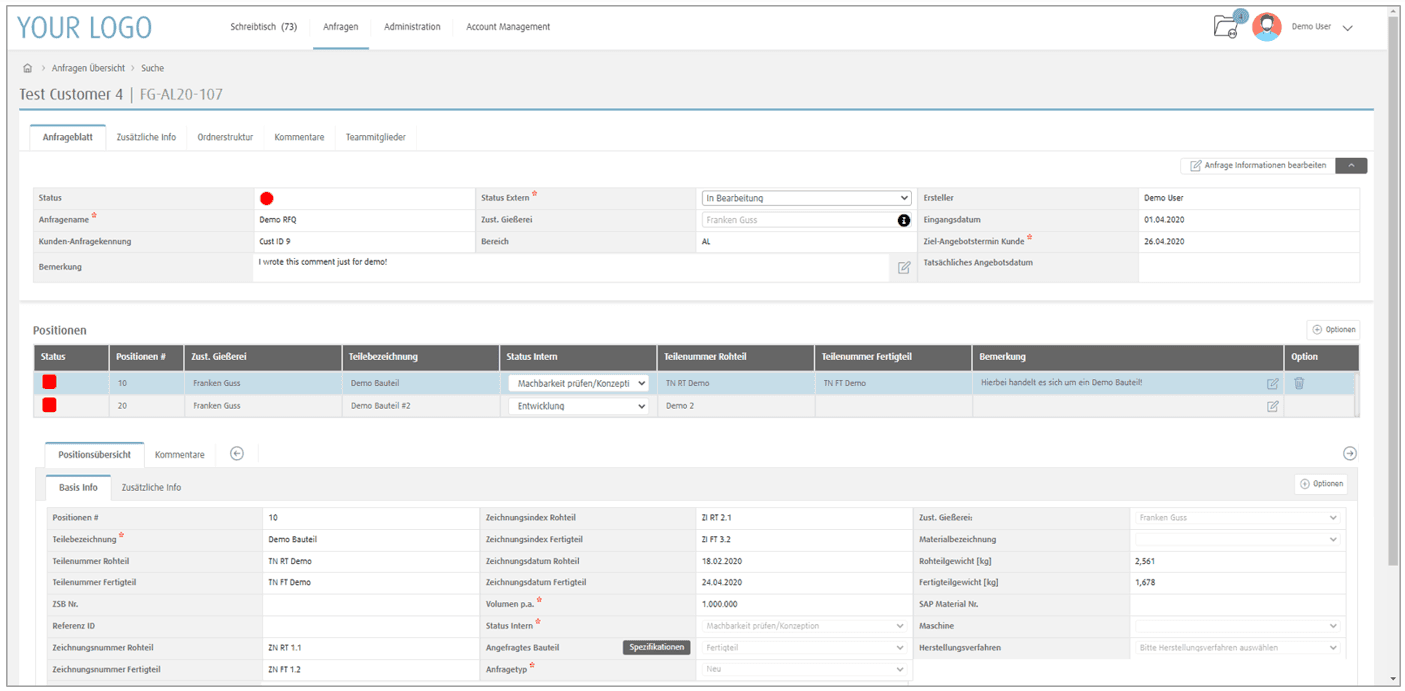
Figure 1: Central RFQ overview: statuses, external status per enquiry, remarks, sales team members, target quotation dates and position counts — with full-text search, advanced filters and time filtering. (Product screenshot with demonstration data.)
Enquiry and position detail
The detail view carries the complete engineering picture. On the enquiry level: customer, responsible foundry, external status, dates and remarks. On the position level: internal workflow status per position, raw-part and finished-part numbers, drawing numbers with dates and revision indices, raw and finished weights, annual volume, requested component type, manufacturing process, machine and SAP material number - plus comments and specifications, where the real technical dialogue takes place.
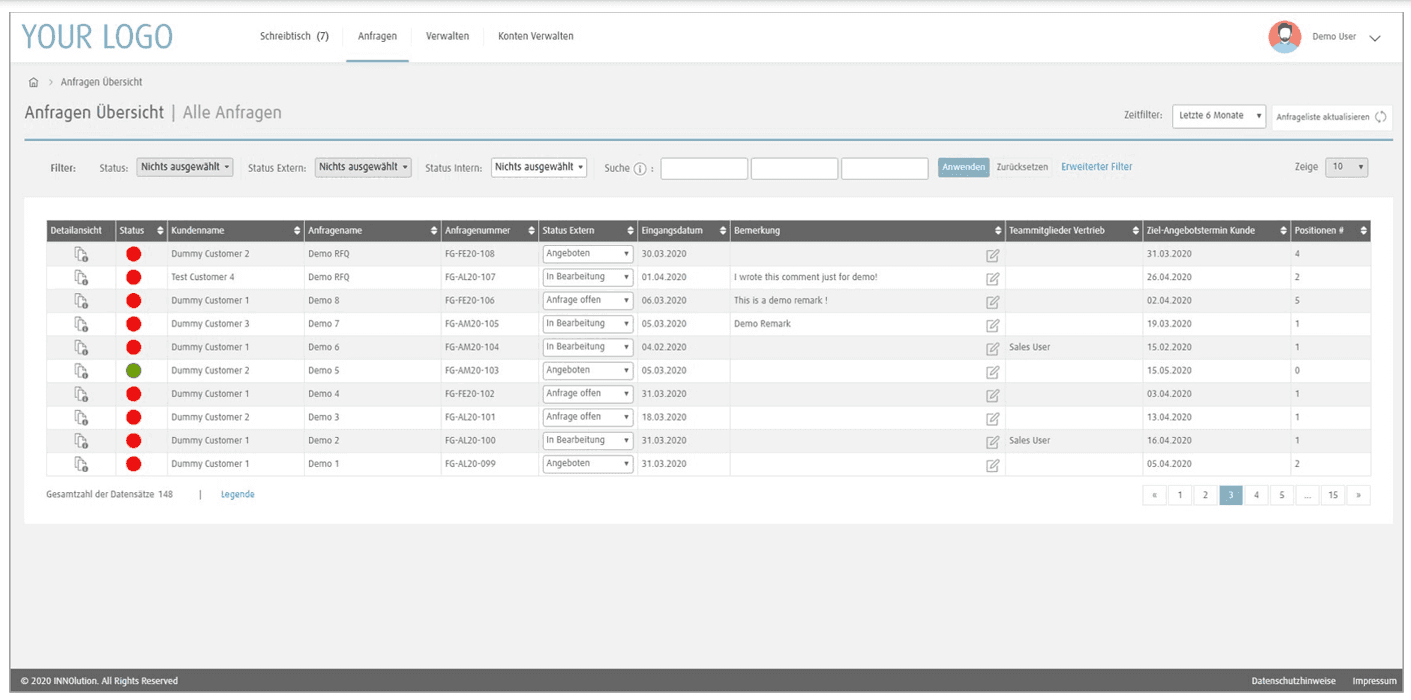
Figure 2: RFQ detail: header data with responsible foundry and external status; position grid with per-position internal workflow status; engineering attributes down to drawing indices, raw-part/finished-part weights, annual volume and manufacturing process. (Demonstration data.)
The dual status model
Internally, a position moves through granular workflow states - feasibility check and conception, development, calculation, quotation preparation. Externally, the customer-facing process knows only four: open, in progress, quoted, closed. Sales always speaks the customer's language; operations always sees the real work. The cross-analysis of both dimensions became one of the most used management views in the platform.
Management reporting from live data
A weekly report - generated directly from the platform - gives management the full picture: the ten-week trend of incoming RFQs per day, total enquiries and positions with period-over-period deltas, hit-rate analysis by outcome (order received, no quotation submitted, declined, quotation sent) compared with the previous year, average cycle times and overdue enquiries, and the cross-view of internal versus external status. What used to be a gut feeling became a number with a trend.
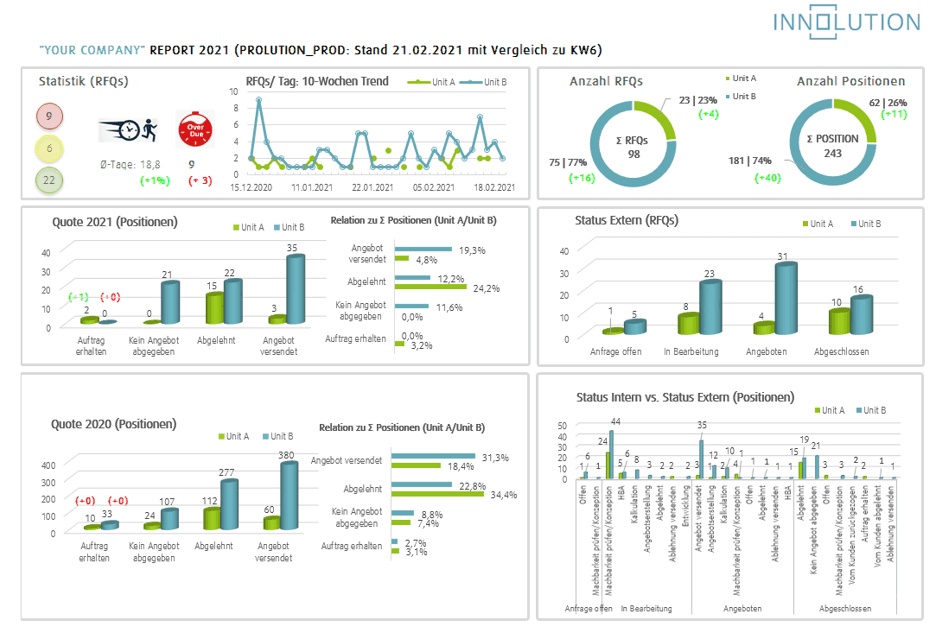
Figure 3: Weekly management report from live platform data: ten-week RFQ trend, volume deltas, hit-rate analysis by outcome (2020 vs. 2021), average cycle time and overdue tracking, and the cross-analysis of internal versus external status. (Demonstration data.)
Integration and operations
REST interfaces connect Prolution to the surrounding system landscape - SAP, MS SQL and Poseidon - for master data and downstream processing. All documents and data are hosted in a German data centre; notification and reminder functions, documented communication and integrated document management round out the platform.
Engineering at Scale: The Team Behind Prolution
Prolution was not a side project - it was built and run with the intensity of a product organisation. ZirkelTech deployed a blended team: product leadership, business analysis, UX and solution architecture in Frankfurt am Main, working directly with Franken Guss stakeholders; backend, frontend, QA-automation and DevOps pods in Delhi NCR, turning the time-zone difference into delivery speed.
At peak, more than 20 specialists worked on the platform in parallel; a core team of around a dozen carried it across the full engagement. The delivery machine ran on more than 70 two-week sprints with joint sprint reviews, a governed backlog and quarterly roadmap planning. Quality was engineered in: automated regression testing, separated development, test and production environments, and release windows aligned with the foundry's working hours - more than 30 production releases without interrupting daily quoting operations. In total, the engagement represents upwards of 50,000 engineering hours, from the first workshop flipchart to the multi-tenant SaaS platform.
Outcomes and Impact
The publicly reported headline came from the market launch itself: Innolution GmbH communicated in 2023 that Franken Guss had accelerated its enquiry procedure by around 30 percent through the platform, while significantly improving collaboration between departments and strengthening its competitiveness.
Behind that number sit structural changes. The enquiry process gained a single source of truth with a complete audit trail. Deadlines became managed objects rather than hopes. Management steering moved from anecdote to KPIs - cycle times, overdue enquiries and hit rates by outcome, unit and year. And the hit-rate analytics enabled a more selective quoting strategy: declining fast where the fit is poor, and investing calculation capacity where orders are actually won.
The strategic outcome went further than process improvement: an internal tool became a marketable asset. With multi-tenancy, white-labelling and demonstration environments in place, Innolution GmbH launched Prolution to the foundry industry as a cloud SaaS product - with Franken Guss as its flagship reference.
From Internal Tool to SaaS Product
Turning an internal application into a sellable product is an engineering discipline of its own. ZirkelTech re-architected Prolution for strict tenant separation, introduced white-label theming so that every foundry operates the platform under its own brand, built onboarding and demonstration environments with realistic sample data, and prepared the platform for a sales motion including free product demos. The screenshots in this case study show exactly that productised state - a neutral “Your Logo” tenant with demonstration data.
For ZirkelTech, this is the defining pattern of the engagement: the same partner that facilitated the first ideation workshop also engineered the product on which a market launch could be built.
← Back to Insights