




Every family knows the standoff: teenagers want to shop on their own terms, and parents want to know what happens to their money. LikeIT - a venture created by Chequered Flag Technologies AG - set out to dissolve that standoff with a mobile platform that lets teenagers shop independently while their parents approve and pay each purchase remotely, in real time, from wherever they happen to be.
Zirkel Technologies was engaged as the end-to-end product partner. Over roughly twenty months, cross-functional ZirkelTech teams in Frankfurt and Delhi took LikeIT from a whiteboard concept to a launched product: market and user research, product strategy, a consumer brand and user experience built for Generation Z, native mobile apps, a cloud platform, a merchant integration concept, and the commercial and investor materials that carried the venture to market.
The defining engineering decision was architectural: LikeIT never touches the money. The platform aggregates established payment methods and moves authorisations and receipts - a QR code stands in for cash at the till. That choice kept the venture outside licensed payment flows, cut merchant integration effort dramatically, and became the product's core differentiator.
LikeIT launched in Germany. Shortly afterwards, the COVID-19 pandemic brought stationary retail - the heart of the LikeIT experience - to a standstill, and the shareholders took the decision to wind the venture down. We tell the story anyway, because the delivery model, the architecture and the lessons have outlived the product - and because honest case studies are worth more than lacquered ones.
The Client and the Idea
Chequered Flag Technologies AG (CFT), a technology venture builder headquartered in Schaan, Liechtenstein, develops digital products and operates them as software-as-a-service. For the LikeIT venture, CFT owned the technology and prepared the market entry, while LikeIT AG - founded in Germany in the summer of 2018 - was set up to run market development, brand building and partnerships: first in Germany, then across the EU-27.
The ambition was explicit: establish the leading platform for mobile payments that serves both sides of the counter - users and retailers - and make mobile payment a lifestyle for what the venture called the Smart Family. ZirkelTech joined at the ideation stage and stayed through launch.
The Problem: Freedom Meets Oversight
Growing up is a negotiation. Teenagers push for independence: shopping with friends rather than parents, making their own choices, being trusted, running their day on their own schedule. Parents carry the duty of care - and the bank account. They want budgets respected, discounts actually used, and no child walking through town with a wallet full of cash.
The result is a structural conflict. Shopping with your parents is not cool at fifteen - but the money still comes from them. Does a parent have to be physically present for every purchase? As mundane as the question sounds, it generates real friction: dissatisfaction, arguments, and a permanent trust deficit on both sides.
It is also a sizeable market. German 14- to 24-year-olds spend billions each year - more than four billion euros on clothing, fashion and jewellery alone, followed by going out, mobile communications, mobility and entertainment. This spending is overwhelmingly funded by parents and still settled largely in cash: invisible to retailers, and hard for families to steer.
The Solution: Receipts, Not Money
LikeIT's answer is a purchase journey that separates presence from control. A teenager shopping with friends photographs the item - the app attaches the price - and sends the request to the parents. They see exactly what is being bought, where and for how much, and approve or decline with one tap, as if they were standing in the store. On approval, they pay the merchant directly through their preferred payment method. LikeIT then issues a QR-coded receipt to both the teenager and the merchant's till; scanning it hands over the goods.
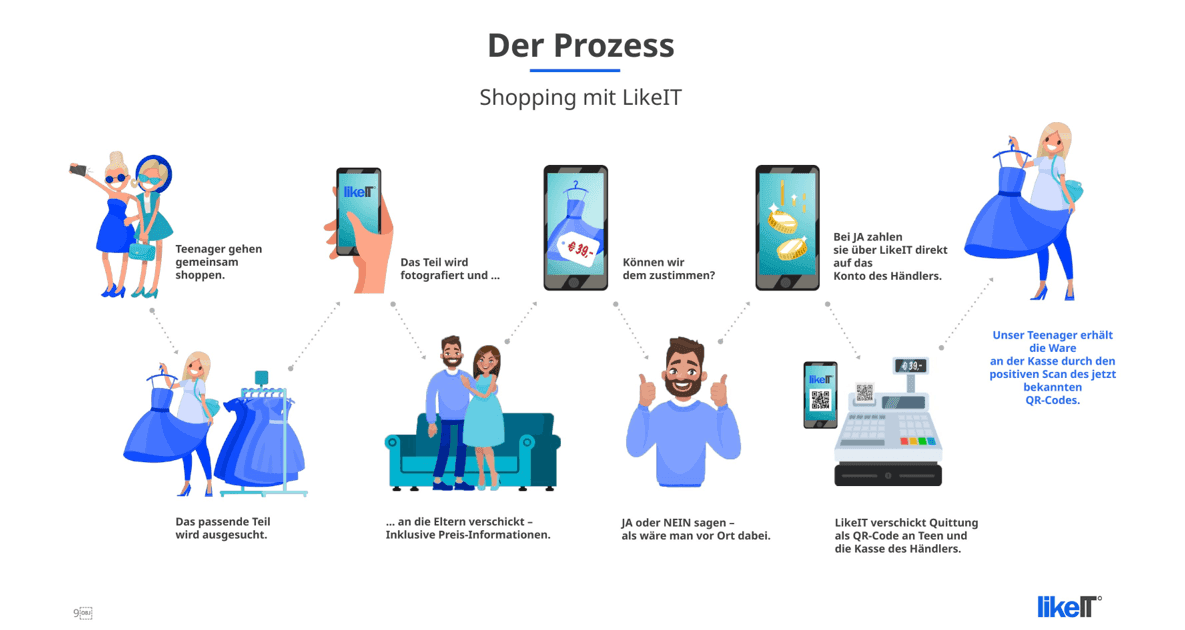
Figure 1: The LikeIT purchase journey: photograph in-store, approve remotely, pay the merchant directly, redeem the QR receipt at the till.
Three principles shaped the platform. First, standardised processes: rather than adding yet another payment scheme, LikeIT aggregates the established ones — cards, PayPal, instant-transfer and wallet schemes — so families pay however they already pay. Second, receipts instead of money: LikeIT never holds or transfers funds; it transports authorisations and proofs of payment. Third, radical simplicity at the point of sale: all a merchant needs in order to honour a LikeIT purchase is the ability to scan a QR code.
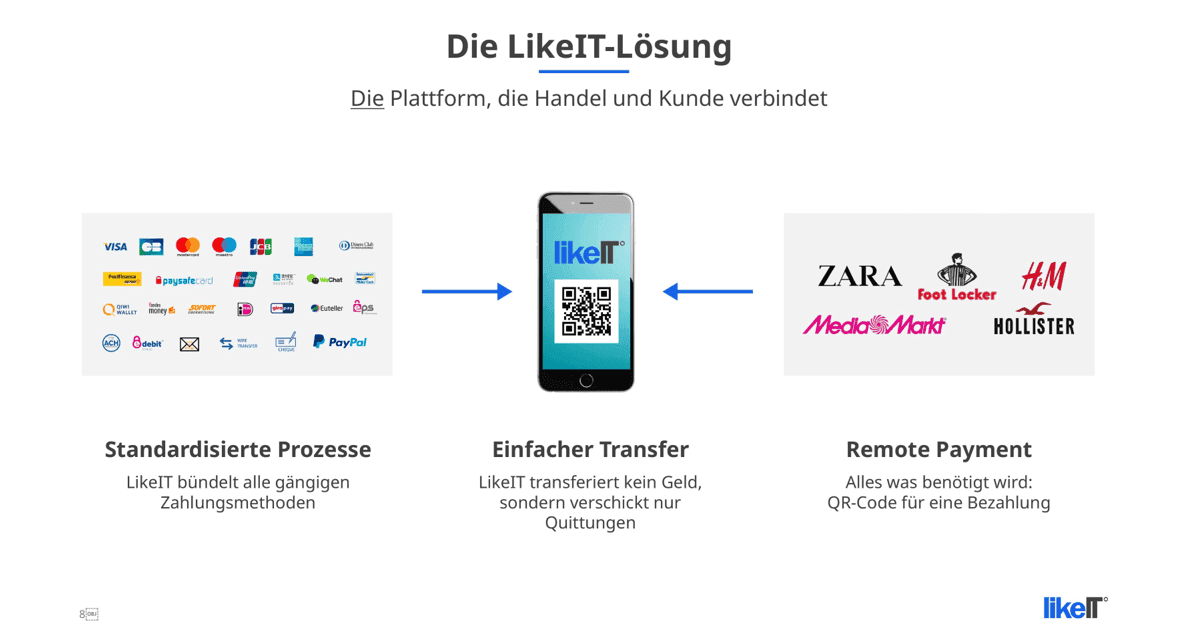
Figure 2: One platform between payment methods and retail: LikeIT aggregates established payment options and moves receipts - not money.
The second principle was the engagement's most consequential engineering decision. By keeping the platform out of the flow of funds, the product avoided the licensing burden of an e-money or payment institution, reduced compliance exposure for an offering aimed partly at minors, and collapsed merchant integration effort to near zero. What looked like a technical subtlety was in fact the business model's protective moat - identified and stress-tested in ZirkelTech's discovery phase, then engineered into every subsequent design choice.
LikeIT never touches the money. It moves authorisations and receipts - and that architectural decision was the business model's moat.
Retail formed the other side of the two-sided design. Every LikeIT transaction converts an anonymous, cash-paying teenager into an identified customer with a purchase history. On that basis, retailers can run personalised campaigns and buying incentives that pull digitally native customers back into their own stores - returning the playbook of online commerce to the high street.
Design: A Brand Teenagers Actually Want
LikeIT needed two faces. Towards investors, retail partners and the payments industry, the venture presented the clean, confident likeIT° corporate identity. Towards its users, it needed something else entirely: a brand teenagers would voluntarily put on their home screen.

Figure 3: Building the consumer brand: a visual world drawn from youth culture, not from banking.
ZirkelTech's experience design team built that consumer identity from the ground up: a hand-written 'like it.' wordmark, a saturated yellow-and-violet palette, and a photographic world borrowed from youth culture rather than financial services. The interface followed the same logic. Instead of imitating a banking app, LikeIT behaves like a social one: a camera-first flow in which teens capture fitting-room moments, tag items with price stickers and share them - except that the recipient is the family, and the outcome is a purchase. The wallet view shows the current balance and the parental top-up history at a glance; the approval flow reduces the parents' role to a single, well-informed yes or no.
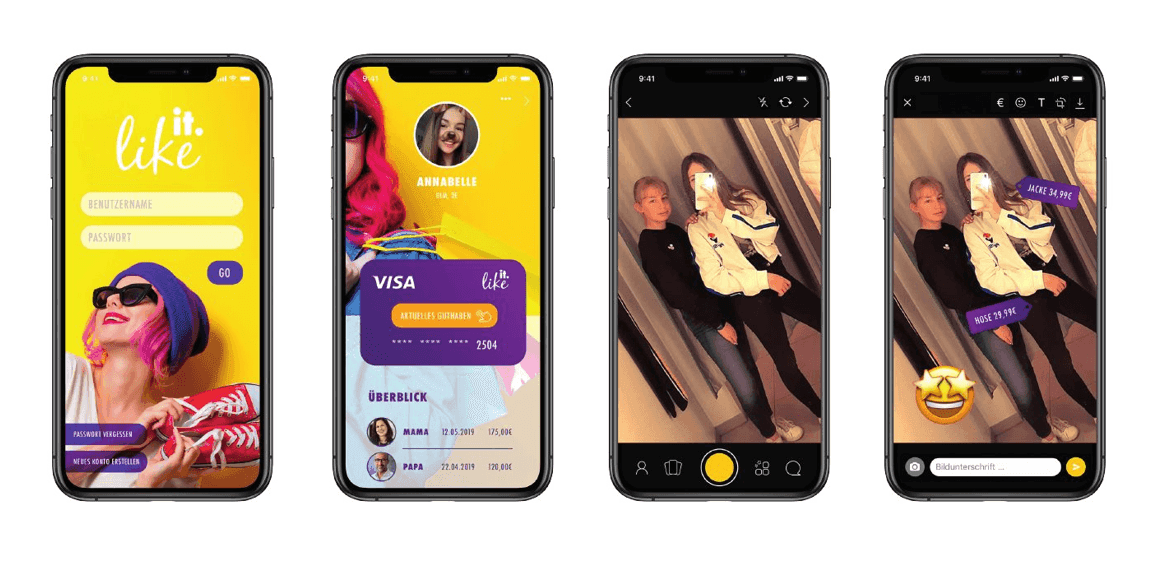
Figure 4: The app experience: social-camera capture with price tags, and a family wallet showing balance and parental top-ups.
The design system was validated in iterative rounds with both audiences - teenagers, who judged whether the app was cool enough to use in front of friends, and parents, who judged whether it was serious enough to be trusted with money. Passing both tests simultaneously was the brief.
Engineering and Delivery at Scale
Taking a payments-adjacent consumer product from zero to launch in under two years required breadth as much as depth. At peak, ZirkelTech deployed a cross-functional organisation of around 35 specialists in seven coordinated workstreams: product strategy and venture design; experience and brand design; iOS engineering; Android engineering; platform and API engineering; quality assurance and test automation; and DevOps, security and compliance - flanked by data and analytics for the retail-facing insight products.
The engagement ran in ZirkelTech's dual-shore model: product direction, design and client-facing workstreams anchored in Frankfurt, engineering scaled out of the Delhi NCR delivery centre - operating as one team on a single backlog. Delivery followed a two-week sprint cadence with joint planning increments across both sites; more than forty sprints lay between the first concept and the launch candidate.
The non-functional agenda was as demanding as the feature set. A payments-adjacent product for families must be exemplary on data protection: the platform was designed around the GDPR from the first sprint - including the parental-consent mechanics of Article 8 for users below the age of digital consent, embedded in onboarding rather than bolted on afterwards. Availability at the point of sale - a QR receipt that must scan reliably at a crowded till - drove the resilience and offline-tolerance requirements on both the apps and the platform.
Go-to-Market and Business Model
ZirkelTech's remit extended beyond the product into the commercial engine room. The addressable market was quantified at roughly 24.5 million people in Germany alone - 9.5 million young people between 14 and 24, plus some 15 million associated parents - and around 173 million across the EU-27, in a cohort where more than 92 percent of teenagers aged 14 and above already use a smartphone. The channel strategy combined social media as the primary growth engine with classic advertising, events and editorial coverage aimed at the parent generation.
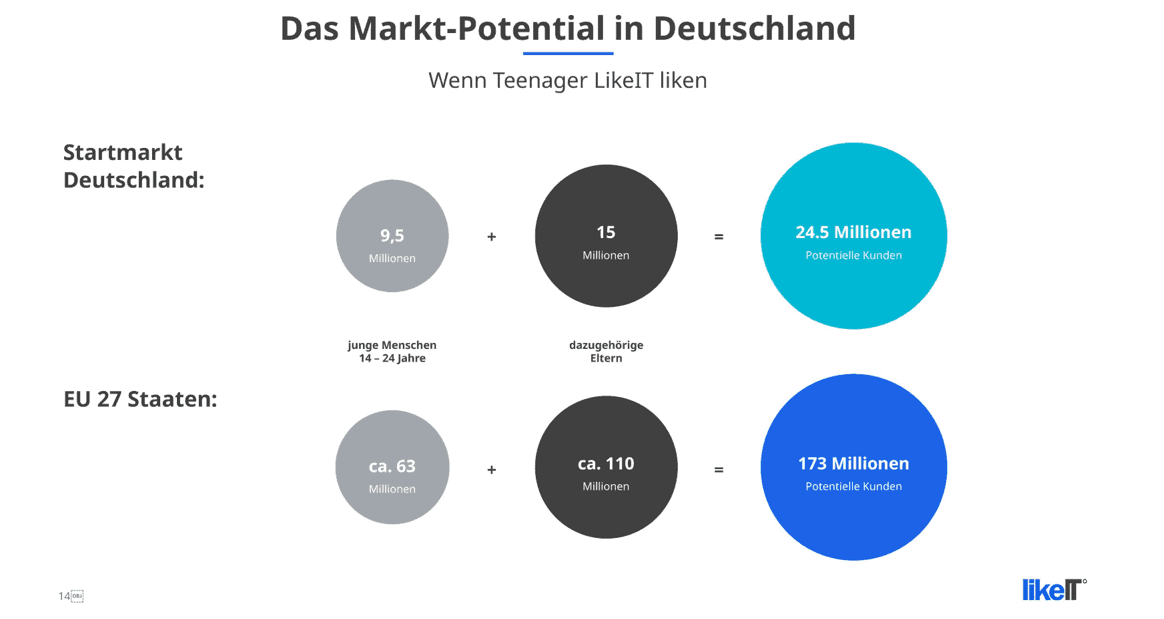
Figure 5: The addressable market: 24.5 million potential users in Germany; around 173 million across the EU-27.
The business model rested on three revenue layers: a free user tier financed through advertising and data services for retail partners; premium and VIP subscriptions at two to four euros per month as the core scaling engine; and advertising, sponsoring, proprietary events and referral commissions on top. The two-year planning scenarios ranged from 100,000 subscriptions (4.8 million euros in annual revenue) through 500,000 (24 million) to 1,000,000 (48 million) - with even the best case assuming a market share of only around four percent. ZirkelTech supported the financial modelling and produced the investor-facing materials for the venture's two financing vehicles (a 750,000-euro raise at CFT level and a 4–5 million euro round for LikeIT AG).
Launch and Outcome
By launch, the engagement had delivered the complete venture stack: native iOS and Android apps, the cloud platform and APIs, the QR receipt engine, the merchant integration concept, the consumer brand and design system, and the commercial and investor documentation. LikeIT went live in Germany as planned - on the scope and on the timeline agreed at the outset.
Epilogue: When the Market Decides
Then the market decided. The launch window collided with the outbreak of the COVID-19 pandemic. Stationary retail - the stage on which the entire LikeIT experience plays out - stayed closed for months, and the social ritual at the product's core, teenagers shopping together in city-centre stores, was suspended indefinitely. For a two-sided platform that needed simultaneous early traction with families and with physical retailers, the timing was unrecoverable. The shareholders took the rational decision and wound the venture down.
We publish this case study anyway, for two reasons. First, because the delivery is the point: the venture failed on market timing, not on execution - the product shipped in full scope, at scale, on schedule. Second, because the lessons compound. Two-sided consumer platforms live or die on the speed of early density, and every plan should model the cold start explicitly. Architectures that stay out of regulated flows create durable optionality - LikeIT's receipt-based design remains, in our view, the right pattern for family commerce. Products used by minors must treat consent and data protection as product features, not as legal footnotes. And venture timing is a risk class of its own: no amount of engineering compensates for a closed high street.
What This Means for Your Product
LikeIT compresses everything ZirkelTech does as a product engineering partner into a single engagement: venture design and validation, consumer-grade experience design, native mobile and cloud engineering, regulation-aware architecture, and the commercial materials that make a venture fundable - delivered by one accountable team across Frankfurt and Delhi. If you are building a digital product - inside a corporation, as a venture builder, or as a founder - the same model applies: one partner from idea to launch, with the engineering depth to scale and the candour to tell you what the market is saying.
← Back to Insights