



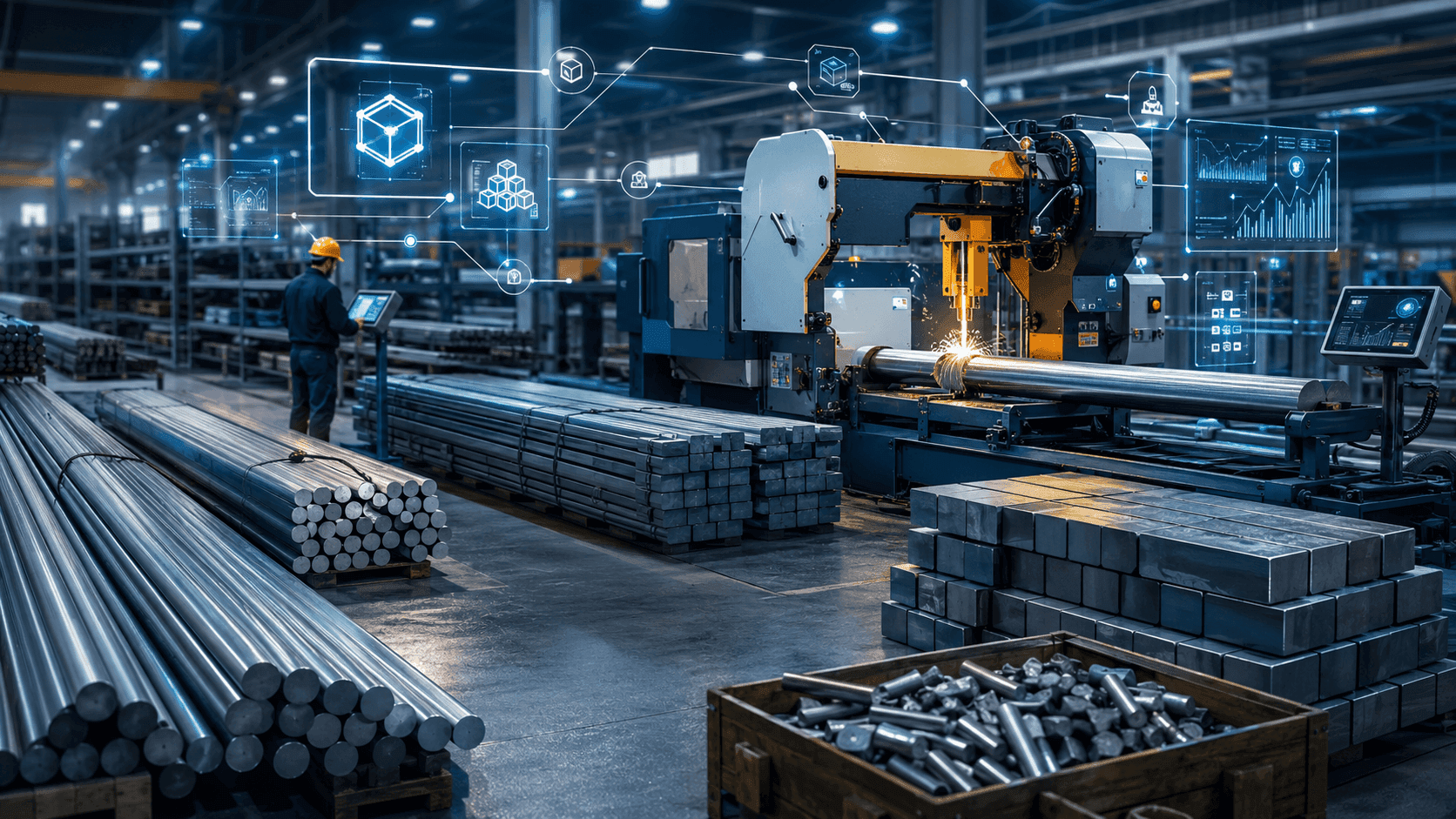
For a stockholding steel distributor, the product is not the bar - it is the length. The core value proposition is buying standard bar stock from the mills and sawing it to whatever dimension the customer's drawing calls for. That business model sits awkwardly in a standard ERP template: every sawn length is commercially a distinct product, yet nobody can maintain a material master for every conceivable dimension, and nobody should have to.
We designed and validated an SAP S/4HANA architecture that resolves this tension with the means of the standard. Roughly twenty configurable product models, clustered by steel grade family and profile type, carry the bills of material and routings for the entire sawn assortment. The existing stock items were not replaced - they became material variants of those models, keeping their material numbers, their stock and their valuation, while gaining a production capability they never had to maintain individually. Each configured sales order line generates its own production order; a table-driven cutting-cost engine prices every cut at order entry; the shop floor runs paperless on touch terminals at the saws, including real-time capture of remnants; and batch traceability from mill certificate to delivery note is a by-product of the process design rather than a reporting exercise.
This paper describes the problem, the architecture and the delivery approach - and why the same pattern applies well beyond steel.
The challenge: when the product is a length
A stockholding distributor's purchased catalogue is finite: grades, profiles, dimensions, mill lengths. The moment a saw enters the picture, the sellable assortment becomes effectively infinite - any bar, any length, any piece count. The classic ERP answers fail at both extremes. Creating a material number per sold length floods the master data and still arrives too late, because the customer's length is only known at order entry. Creating no material at all means no bill of material, no routing, no cost, no traceable product - the cut becomes an invisible warehouse activity that happens to consume steel.
Cost is the second pressure point. The cost of a cut varies with profile, cross-section, grade and the number of cuts per order line. Where the ERP cannot compute this, pricing migrates into spreadsheets and experience - workable, until the margin of an individual order line needs to be defended, or the person with the experience is on holiday.
Material reality is the third. Sawing a six-metre bar to customer lengths leaves a remainder that is neither scrap nor a full bar. Remnants (Reststücke) are working capital; they need to return to stock valuated, batch-true and findable for the next order, not accumulate as untracked offcuts along the saws. And in steel, traceability is contractual: works certificates per heat and batch, chemical and mechanical values that must be checkable at goods receipt and printable at delivery.
Finally, the dual-path problem. The same physical bar is sold as-is today and cut to length tomorrow. Splitting it across two material numbers splits stock, availability checking and purchasing. Whatever the architecture, it had to preserve one stock and one material number while supporting two fundamentally different commercial processes.
The architecture: one product model, every length
We resolved these constraints with a hybrid variant-configuration architecture - deliberately close to the SAP standard, with custom logic only where the standard has a genuine gap.
Configurable products, existing items as variants
The assortment is clustered into roughly twenty configurable product models (KMATs), grouped by steel grade family and profile type. Each model carries a super bill of material and a routing that describe how any length is cut from bar stock. The existing stock items were not replaced: they became material variants of these models. They keep their material numbers, their stock and their valuation - and inherit, through the model, a bill of material and routing they never have to maintain individually. The same item can therefore be sold from stock without any configuration, or run through the model as a configured cut: two commercial paths on one material master.
Decisions of this kind are one-way doors. Once a stock item is bound to a product model as a variant, there is no elegant path back - so we validate exactly these steps in a sandbox against real materials before committing anything. In our experience, this discipline costs days and saves months.
From sales order to saw: make-to-order with a hand brake
Each configured order line generates its own production order automatically - the sales order is the demand, with no planning run in between. We deliberately did not make this fire-and-forget. Automatic order creation is gated by commercial release of the sales order, and release to the shop floor is a controlled, periodic step rather than continuous auto-release. The work queue at the saws remains a management decision, not a side effect of order entry.
One adoption detail we would flag to anyone taking this route: sales-order-driven manufacturing looks unfamiliar in the transactions planners have used for years, and some habitual order-creation paths become actively wrong. We design the role menus and the training so that the organisation meets the new logic prepared rather than surprised.
Costing the cut, pricing at order entry
Standard product costing wants a bill of material and activity rates; a saw wants to know cross-section, grade and cut count. We closed that gap with a table-driven cutting-cost engine - maintainable by the business, not by developers - that computes the cost of each configured line and feeds a price recommendation directly into the sales order, date-dependent for future delivery dates. The commercial effect is simple: the margin of a cut is visible at order entry, not at month end.
Warehouse, batches, remnants, certificates
Batch determination runs strictly first-in-first-out, taking the discussion about which bar to pull out of the aisle and into the system. A virtual cutting location gives the in-process flow a proper home in warehouse management: bar in, cut pieces and remnant out. Remnants return to stock as valuated, batch-true inventory - visible for the next order instead of disappearing into the shadow economy of the saw hall. Batch classification carries the chemical and mechanical values from the mill certificate; ranges are checked at goods receipt, and works certificates are printed from the system at delivery. Traceability from mill heat to customer delivery note is complete - not as an audit exercise, but because the process design leaves no gap for it to fall through.
Paperless at the machine
A purpose-built touch terminal (SAP Fiori) runs at five saws. Operators confirm operations, post goods movements and capture remnants at the machine, in real time - no paper travellers, no end-of-shift backlog of postings. Saw assignment deliberately stays on the shop floor, where the knowledge is: circular saws for the smaller cross-sections, band saws above, some machines combining cutting and chamfering in a single setup. The terminal supports that decision; it does not pretend to make it.
How we delivered
Proof of concept first. The architecture was proven end-to-end on real materials - from configured quotation line to confirmed cut, remnant return and printed certificate - before any rollout build. Variant-configuration architectures earn trust in the concrete, not on slides.
Every design decision is recorded in a decision register and countersigned by client and consultant. We have learned, at times the hard way, that the expensive decisions in an SAP project are rarely the wrong ones - they are the undocumented ones. The same discipline applies to changes: nothing in a shared configuration is deleted without explicit confirmation from both sides.
The expensive decisions in an SAP project are rarely the wrong ones - they are the undocumented ones.
Finally, we map irreversibility. Steps with no return path - and variant configuration has several - are validated in a sandbox before they touch a shared system. Everything else can move fast.
What the numbers say - and what they don't
The structural results are unambiguous. Master data effort concentrates in roughly twenty product models instead of spreading across every conceivable length; no new material numbers are created per customer dimension. Every configured order line carries its own cost and its own price logic at the moment of entry. Every batch carries its certificate. Five saws run paperless, and remnants are captured where they physically occur.
We deliberately report structural outcomes here rather than projected savings. Operational KPIs - order-entry effort, throughput per saw, margin accuracy - are being baselined against the legacy process and will follow in an update of this case study once they are measured in live operation. We prefer reporting numbers we can stand behind to numbers that look good.
Beyond steel
The pattern is not a steel specialty. It is the general shape of every business whose promise is standard stock in, customer dimension out: metal service centres, plastics and composites, timber, cable and wire, glass. Wherever the product is “our stock, your dimension”, the same architecture applies - a handful of configurable models instead of an exploding material master, cost-true cutting logic at order entry, remnants as managed inventory, and execution captured at the machine.
If parts of this description sound like your operation, the distance to a working proof of concept is shorter than you might expect.
← Back to Insights